Frontline teams need rapid pre-shift status screening.
← Back to cases
SAFETY RISK AGENT
Employee Health Monitoring & Fatigue Risk Analysis
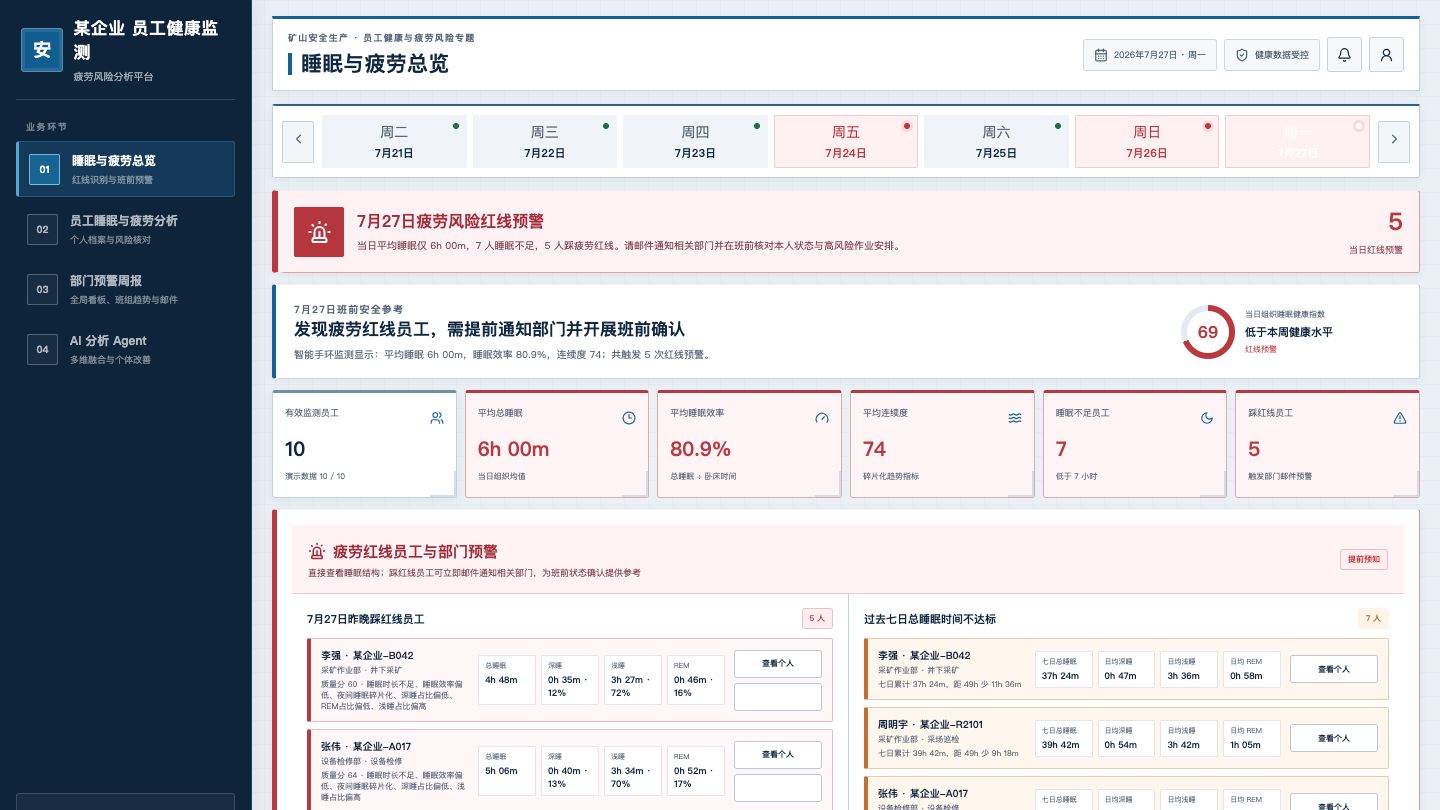
Use wearable data to support pre-shift fatigue risk screening, alerts, weekly reports and documented review.
FIT / BUSINESS ENTRY
Where it fits
Start with a bounded, verifiable workflow and keep human control at critical steps.
Wearable metrics are difficult for operational teams to interpret.
Sleep and physiological anomalies require human review and records.
Management needs trend reports rather than isolated readings.
Sensitive health data requires strict access and audit controls.
FLOW / CONTROLLED EXECUTION
Core workflow
Six steps connect business input to a reviewable, archived result.
Bind devices
Maintain controlled employee, device and team mappings.
Ingest data
Sync sleep, heart rate, blood oxygen and HRV indicators.
Check quality
Detect missing, abnormal or low-confidence readings.
Apply rules
Assign explainable risk levels using safety rules.
Human review
Confirm alerts, actions and review notes.
Report trends
Produce individual, team and periodic summaries.
DEMO VIDEO
Sanitized walkthrough
The video shows product capabilities and interaction patterns without exposing client identity or access credentials.
DEMO SCOPE
What to look for
Connect wearable data with pre-shift safety workflows to identify unusual sleep, heart-rate and blood-oxygen indicators and support documented review.
- Multi-indicator normalization and quality checks
- Rule-first fatigue-risk assessment
- AI explanations, alert wording and weekly summaries
- Review and action audit trail
AI CAPABILITY
Capability modules
Each module connects back to enterprise data, rules, permissions and human review.
Multi-indicator normalization and quality checks
Rule-first fatigue-risk assessment
AI explanations, alert wording and weekly summaries
Review and action audit trail
Role-based access to sensitive data
DELIVERY BOUNDARY
Recommended first-release boundaries
Make the first release testable and reviewable before expanding integrations.
Controlled boundary
This is a safety-support tool, not a medical diagnostic system.
Controlled boundary
Health-risk outputs should not be used directly for discipline or performance scoring.
Controlled boundary
Acceptance should focus on explainability, false-alert review and access controls.
VALIDATE WITH YOUR DATA